The first piece of copy I ever wrote for a Saudi audience, I got it wrong. Not in an embarrassing way. Nobody called. Nobody complained. But I knew. The words were technically correct. The Arabic was grammatically sound. It just felt like it had been written by someone standing outside a window, describing what they saw through the glass.
That’s the problem with most content written for Saudi Arabia. It is accurate but not alive. It knows the facts but not the feeling. It can tell you that Saudi Arabia has 13 regions, each with its own dialect, traditions, and culinary identity. What it cannot do is make you understand what it means to read your brand name in Hijazi Arabic and feel, instinctively, that this brand gets you.
That difference, the gap between technically correct and genuinely resonant, is what Taglime was built to close. Eight years and 6,500+ projects later, here is what we have learned about writing for Saudi audiences.
Writing for Saudi audiences means creating content that reflects how Saudis actually think, speak, and make decisions, not a translated version of content written for someone else.
Unlocking Local Trust: Essential Arabic Copywriting Tips for the Saudi Market
Mastering the art of localized messaging requires far more than just a firm grasp of grammar; it demands a deep understanding of the specific cultural nuances that define the Kingdom. One of the most essential Arabic Marketing Copy tips for international brands is to move away from the rigid, cold formality of Modern Standard Arabic in consumer-facing channels. Instead, brands should adopt the “White Dialect,” which successfully bridges regional differences and creates a conversational, human tone that resonates deeply with the modern Saudi shopper.
Effective digital engagement in the Middle East also hinges on how well a brand can navigate the specific social sensitivities of its audience. Among the top Arabic Marketing Copy tips for 2026 is the absolute necessity of a rigorous cultural check to ensure that all metaphors, idioms, and visual references align perfectly with local values. A direct translation of a Western slogan often results in a jarring “register mismatch,” where the tone feels either too aggressive or unintentionally distant, leading to a quiet but significant disconnect with your target demographic.
Finally, optimizing for search visibility in the Saudi market requires a shift toward an Arabic-first strategic mindset. Many businesses fail because they simply translate English keywords, but seasoned experts suggest that the best Arabic Marketing Copy tips focus on how local users actually phrase their queries in real life. By building info-heavy content that addresses the specific aspirations and lifestyles of the Saudi people, brands can establish true institutional trust and secure a dominant position in an increasingly competitive digital landscape.
TL;DR
Saudi Arabia is not one audience; it is 13 regions with distinct dialects, values, and cultural registers. Poetry is not decoration here; it is the original communication technology. Local brand pride is surging, with 83% of young Saudis saying they are proud of their heritage, and that pride now showing up in purchasing decisions. Fus’ha signals formality, not connection. Taglime has written for Saudi audiences since 2017, across dialects, sectors, and generations.
Rule 1: Understand that Saudi Arabia has always been a storytelling civilization
Before there were agencies, before there were brands, before anyone had thought to put a logo on a camel, the Arabian Peninsula had the Rawi.
The Rawi, or storyteller, was the keeper of history and poetry. They memorised epics, legends, and genealogies and passed them from generation to generation, ensuring that knowledge and memories lived on. In Bedouin society, the Rawi functioned as a living archive, serving as teacher, recorder of tribal victories, and entertainer all at once. Their aim, as one Riyadh-based communications professional puts it, was never applause. It was to foster understanding, create belonging, and ensure continuity.
That tradition did not disappear. It evolved.
An old saying describes poetry as the Arab’s book. Saudi Arabia is the land that produced Imru Al-Qais, Zuhair bin Abi Salma, Antarah ibn Shaddad, and dozens of other poets whose verses are still quoted in conversation, in business meetings, and yes, in marketing campaigns that actually work.
Poetry in Saudi literature prevails over the novel and prose works, enjoying wide popularity among the public, unlike literary traditions in many other cultures. This is not nostalgia. It is a live preference.
What does this mean for your brand? It means that rhythm matters. Cadence matters. The way a sentence lands matters. Saudi audiences are not just reading your copy. They are feeling whether or not it sounds right. A tagline that has internal music will outperform one that is merely logical. Every time.
Rule 2: Karam is not a nice value to mention. It is the operating system.
Generosity, courage, hospitality, and maintaining strong family relationships are core social values that shape Saudi life. But of these, generosity, or كرم (karam), is the one that most brands underestimate.
Karam is not just a cultural value to nod at in your Ramadan campaign. It is the lens through which Saudi audiences evaluate whether a brand deserves space in their lives. A brand that hoards, withholds, or feels transactional does not register as modern or sophisticated. It registers as stingy.
Generous copy is specific. It gives the reader something real, a piece of knowledge, a genuine offer, a moment of recognition. “Thank you for choosing us” is not generous. It is a receipt. “We built this for you, and here is exactly why” is generous. That distinction is the difference between copy that converts and copy that sits there looking polished.
This is also why word-of-mouth carries immense weight in the Saudi market, where the close-knit nature of society and the emphasis on personal relationships make recommendations and referrals highly influential. Karam in your product and communication, gets talked about. Stinginess gets quietly dropped.
Rule 3: Local pride is not a trend. It is a psychological shift.
Something important happened in Saudi Arabia over the last decade. The default assumption, that global equals better, started to dissolve.
In 2025, Saudi shoppers are no longer chasing global logos by default. They are choosing local “hero brands” that reflect identity, pride, and cultural confidence, and this shift is most visible among Gen Z, who now see Saudi-made products as cooler, more authentic, and more meaningful than foreign alternatives.
The numbers behind this are striking. In YouGov’s 2025 Most Recommended Brands ranking, Saudi names outperformed many global players, with Saudia scoring 91.0 and Albaik following closely at 88.7.
This is not anti-global sentiment. It is pro-Saudi confidence. And it has a direct implication for how international brands should write. Content that positions itself as bringing sophistication to Saudi Arabia has lost before it started. Content that arrives with respect, curiosity, and genuine cultural fluency has a real chance.
The Ministry of Culture put it plainly: the Saudi Vision 2030 states that culture is “indispensable to our quality of life.” That is not a branding line. That is a governing principle. Brands that treat Saudi culture as a backdrop will be tolerated. Brands that treat it as the actual subject will be trusted.
Rule 4: Fus’ha is not the safe choice.
This is the one that still catches brands out, even experienced ones.
The assumption goes like this: Saudi Arabia is conservative, formal Modern Standard Arabic (Fus’ha) is the safe register, so use Fus’ha for everything, and you cannot go wrong.
Fus’ha is the language of formal institutions, news broadcasts, government documents, and academic texts. It is not how Saudi people speak to each other, think through decisions, or talk to their families. When a consumer brand writes in pure Fus’ha, the reader does not feel respected. They feel addressed. There is a difference.
Saudi Arabia has 13 regions, each with a unique dialect, traditions, heritage, and culinary identity, and those dialects carry emotional weight that Fus’ha simply cannot access. Najdi Arabic signals authority and confidence. Hijazi Arabic feels warm, sociable, and coastal. The White Dialect, or Arabic Faseh, sits in the middle and has become the digital register of choice for modern Saudi brands. Nabati poetry, inspired by local dialects and popular among wider circles, has been the form that Saudis reach for when they want to feel something.
Choosing the wrong register does not just produce a flat copy. It produces copy that the audience cannot trust because it does not sound like anyone they know.
Taglime writes in all four registers. That sentence took eight years to be able to say honestly.
Rule 5: The audience is young, digital, and allergic to performance.
By 2035, millennials, Gen Z, and Gen Alpha will represent 83% of Saudi Arabia’s population and control 77% of household income. That audience is already making decisions. They are not waiting for 2035.
Saudi Arabia has a staggering social media penetration, with platforms like X, TikTok, and Snapchat dominating daily life and shaping purchasing decisions. 99% of Saudis use social media, with WhatsApp, Snapchat, and YouTube ranking highest in usage.
And this generation can smell inauthentic copy from three screens away. Saudi Gen Z values authenticity, social critique, and emotional honesty. They do not want a brand to perform care. They want a brand to demonstrate it, in the specific, the real, the particular.
Copy that hedges, that speaks to everyone, that uses the same tone for a Saudi teenager as for a government procurement officer, is copy that speaks to no one. The Saudi digital audience rewards specificity the same way their ancestors rewarded a well-crafted verse: they share it, quote it, and claim it as their own.
Rule 6: The calendar is not a backdrop. It is the whole stage.
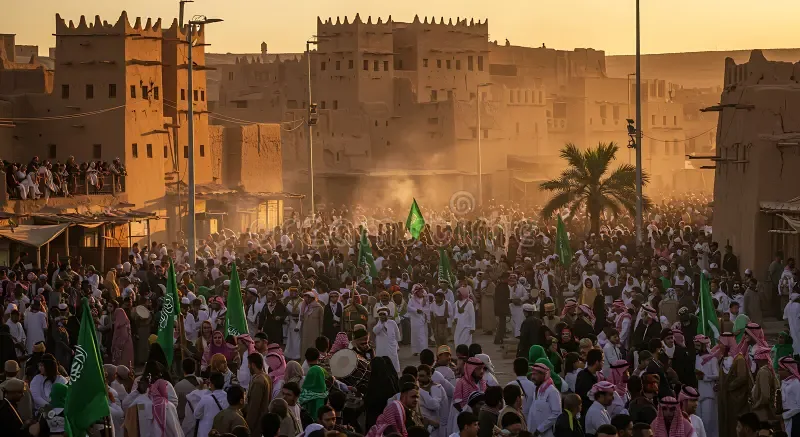
Ramadan. National Day. Founding Day. Eid. These are not seasonal marketing windows to drop a themed banner into. They are emotional peaks in the Saudi year, each with its own texture, register, and unspoken rules.
Ramadan copy should feel generous, reflective, and slow. It is the time of inward attention. Brands that come in loud during Ramadan have misread the room so badly that no amount of gold calligraphy can rescue them.
Hospitality brands often fall into visual clichés: lanterns, gold calligraphy, overused crescents. One of the most Cultural fluency doesn’t require abandoning symbolism. It requires intention.
National Day and Founding Day are different. They carry national pride, celebration, and an increasingly sophisticated sense of what it means to be Saudi today. Cultural event attendance in Saudi Arabia exceeded 23.5 million between 2021 and 2024, and major festivals such as the Red Sea Film Festival and the Islamic Arts Biennale have become global draws. These are not small moments. They are the moments the Saudi audience is most awake, most emotionally open, and most unforgiving of brands that get the tone wrong.
Writing for these moments requires someone who has lived through them. Not someone who has researched them.
Rule 7: Family is the unit. Not the individual.
Western marketing defaults to the individual. The independent decision-maker, the self-optimizing consumer, the autonomous adult making a rational choice.
Saudi audiences think in a different unit. Family values hold significant importance in Saudi Arabian culture. Family-centric marketing strategies, such as portraying familial relationships and celebrating cultural festivities, create an emotional connection and evoke a sense of belonging.
This is not a conservative constraint to work around. It is a creative opportunity. Copy that frames a purchase as a decision that serves the family, that earns respect in a household, that a parent can feel proud of in front of their children, lands differently than copy about personal gain.
It also means that conversion is often not a solo act. The Saudi consumer consults, asks around, and builds consensus. Your copy needs to travel. It needs to be the kind of sentence someone forwards to a family WhatsApp group at 11 pm, and that survives the thread. That is a real brief.
Rule 8: Arabic is not a translation. It is a separate creative decision.
This is the rule that most brands learn expensively.
The process usually looks like this: English copy is created, reviewed, signed off, and then handed to a translator for Arabic. The translator does a competent job. The Arabic is published. Nothing happens. The campaign lands flat in the market. Everyone is confused because the English version worked fine.
The Arabic version worked fine, too. It just was not written. It was converted.
It is impractical and useless to simply “Arabize” English copy for the Arab region. Writing culturally sensitive copy goes beyond translation. Copywriters need to understand the local context, idioms, and cultural references and immerse themselves in the local culture to create content that connects authentically.
Arabic is a right-to-left language with a 16-century literary tradition, an oral heritage, a deep relationship between sound and meaning, and a set of emotional registers that have no English equivalent. A brand voice that works in English has to be rebuilt in Arabic. Not translated. Rebuilt.
This is not a small distinction. It is the entire job.
At Taglime, we create Arabic-first content where the brief calls for it. Where the campaign is bilingual, our Arabic and English are written in parallel, by writers who think in both languages, not writers who move from one to the other. The result is a copy that sounds like it was always meant to exist. In both languages. For this audience.
What happens when brands skip these rules?
They produce content that Saudi audiences can identify immediately as foreign. Not because it contains a cultural error. Often it contains no errors at all. It is just content that could have been written by someone anywhere, for someone anywhere.
Saudi audiences in 2025 are sophisticated, culturally confident, and surrounded by local content that actually speaks to them. The bar for international brands is higher than it has ever been. And it is going to keep rising.
The brands that are winning here, from global multinationals to new Saudi-born companies, are the ones that chose to understand the audience before writing for them. That is not a content strategy. That is respect. And in Saudi culture, respect is where every meaningful relationship begins.
Work With Writers Who Grew Up In This Industry.
Taglime is a Saudi-founded copywriting and localization agency that has been writing for Saudi audiences since 2017. Our team covers Najdi, Hijazi, White Dialect, Fus’ha, and English, not as language options on a dropdown but as distinct creative registers that we choose deliberately based on who you are talking to and what you need them to feel.
We have written for Saudia, PIF, Red Sea Global, NEOM, New Murabba, Qiddiya, and the Saudi Ministry of Hajj and Umrah, among many others. Our repeat client rate in 2025 was 78%. That number means something to us.
If your Saudi content is not landing, or if you are about to enter the market and want to do it right from the first word, get in touch for more Arabic marketing copy tips.
Frequently Asked Questions (FAQs)
Is Saudi Arabia one audience or many?
Many. Saudi Arabia has 13 regions, each with its own dialect, cultural identity, and consumer sensibility. Najdi audiences in Riyadh, Hijazi audiences in Jeddah, and younger digital-native audiences across the country all respond to different registers and tones. Treating the Kingdom as a single homogeneous market is the most common and most expensive mistake international brands make.
Why can’t I just use Fus’ha for all my Saudi Arabic content?
Fus’ha is Modern Standard Arabic, the language of formal institutions, government documents, and news broadcasts. It is not the language Saudis use to talk to each other, think through decisions, or engage with brands they trust. Consumer-facing copy written in pure Fus’ha feels distant and institutional. It does not build the kind of connection that drives purchase decisions.
What does karam mean, and why does it matter for brands?
Karam is the Arabic word for generosity, and it is one of the foundational values of Saudi culture. For brands, it translates directly into copy and communication: content that gives something real, that does not feel transactional, and that respects the audience’s intelligence. Brands that feel stingy with information or warmth do not earn trust in this market.
How do I know which Saudi dialect or register to use?
The choice depends on three things: who your specific audience is, which platform you are writing for, and what emotional register the content needs to occupy. A consumer brand targeting Riyadh-based millennials on Snapchat uses a different register than a government entity publishing an institutional report. Getting this wrong does not just produce flat copy. It produces copy that the audience quietly distrusts.
Does local pride really affect purchasing decisions in Saudi Arabia?
Yes, and it is accelerating. Research from YouGov in 2025 found that Saudi-named brands outperformed many global players in recommendation rankings, and 83% of young Saudis say they are proud of their heritage. That pride now shows up directly in what they buy and which brands they choose to associate with.
If you have read this far, you understand what Taglime is better than any brochure could explain.
We look forward to making your brand the next story we give a voice to.
Reach us at [email protected] or visit taglimeagency.com