TL;DR
- Giga project content writing covers naming, bilingual brand narratives, website copy, placemaking language, and institutional communications
- The most consistent mistake is treating Arabic as the second language in a bilingual brief, built after English decisions are made
- Naming is the hardest and most underscoped content discipline in any giga project brief
- Bilingual does not mean two versions of the same content; it means two conversations achieving the same effect on different audiences
- Taglime has written for Qiddiya, Amaala, Red Sea Global, New Murabba, and NEOM’s Royal Reserve since 2017
What Is Giga Project Content Writing?
Giga project content writing is the creation of bilingual Arabic and English communications for Saudi Arabia’s mega-scale Vision 2030 developments: brand narratives, naming systems, website copy, placemaking language, campaign content, and institutional communications that must speak to international investors, Saudi nationals, global media, and government stakeholders simultaneously.
Unlike standard corporate copywriting, giga project content sits at the intersection of nation-building, cultural identity, and commercial ambition. Every word is accountable to a vision that is both deeply Saudi and designed for the entire world.
Taglime is a Saudi-focused copywriting and localization agency founded in Riyadh in 2017. Over eight years, we have written content for Qiddiya,Amaala,Red Sea Global,New Murabba, and NEOM’s Prince Mohammed bin Salman Royal Reserve. This is what I have learned, honestly.
Nobody Tells You What the Brief Actually Is
Every giga project brief I have ever received has said some version of: “We need Arabic website copy that matches the English brand voice.” Simple, right?
It never is.
What the brief actually means, once you are inside the work, is this: write Arabic content that honors Saudi cultural identity without feeling provincial. That speaks to Saudi nationals without alienating international audiences. That matches a global English brand voice without sounding like a translation. That goes through an approval process involving Saudi government stakeholders, a U.S. design agency, a London PR firm, and three internal communications teams, none of whom agree on what the Arabic should sound like.
That is the real brief. And no one puts that in the email.
“I stopped being surprised by this in year three. A client sends a simple request. By month two, we are building an entire naming system from scratch. The brief is always a starting point, never a specification.” (Laila Essa, Co-Founder, Taglime)
What this means practically: any agency taking on a giga project content needs the flexibility to grow with the brief, the relationships to navigate institutional approval, and enough cultural standing to push back when the direction is wrong. If they cannot do all three, the content will suffer.
The Arabic Problem Is Bigger Than Most People Think
Here is a pattern I have watched repeat itself across the industry for eight years.
An international agency develops the English brand narrative. The design team builds the English website. Months of work, multiple rounds, and everyone is aligned. And then, near the end, someone turns to the room and asks: “Who is handling the Arabic?”
By that point, every structural decision has been made in English. The information hierarchy is English. The tone of voice is English. The word counts are calibrated for English. The Arabic copy that gets produced at that stage is either a translation (which defaults to Fus’ha and loses the brand voice entirely) or a forced localization trying to fit Arabic thinking into a structure that was built for someone else’s language.
This is how Saudi giga projects end up with Arabic content that feels like a subtitled film. Technically correct. Emotionally foreign.
Arabic is not a second language in Saudi Arabia. It is the first language, the cultural language, the language in which Saudis feel things. When a giga project gets its Arabic wrong, Saudi audiences notice. They may not articulate it as a dialect issue or a register problem. They will just feel, somewhere, that the project was not really built for them.
The fix is structural, not cosmetic. Arabic and English content need to be developed in parallel, with dialect decisions made at the briefing stage, not the delivery stage.
When we built the Arabic brand voice for Amaala from zero, the brief was specifically to develop a tone conceived in Arabic, not adapted from English. The difference in the output was not subtle. It was the difference between content that reads like luxury Arabic and content that reads like luxury English in an Arabic font.
Naming Is the Hardest Job in the Room. Trust Us
I want to spend a moment on naming because it is consistently the most underestimated scope item in any giga project brief.
Saudi Arabia’s giga projects are designed to be places where Saudis find excitement, inspiration, and creative communities. Arab News. Every one of those places needs a name. Not just a project name. Districts. Neighborhoods. Retail concepts. Hospitality venues. Parks. Plazas. Pedestrian routes. Viewpoints. Every element of a development that will exist for a hundred years needs a name that will still make sense in a hundred years.
A giga project name in Saudi Arabia has to work phonetically in Arabic across Najdi, Hijazi, and White Dialect registers. It cannot carry unintended negative associations in any major Saudi dialect. It needs to be globally pronounceable. It should ideally connect to Arabian heritage, geography, or cultural meaning. It has to survive a trademark and commercial register check. And, because we live in this world, it needs to fit in an Instagram bio.
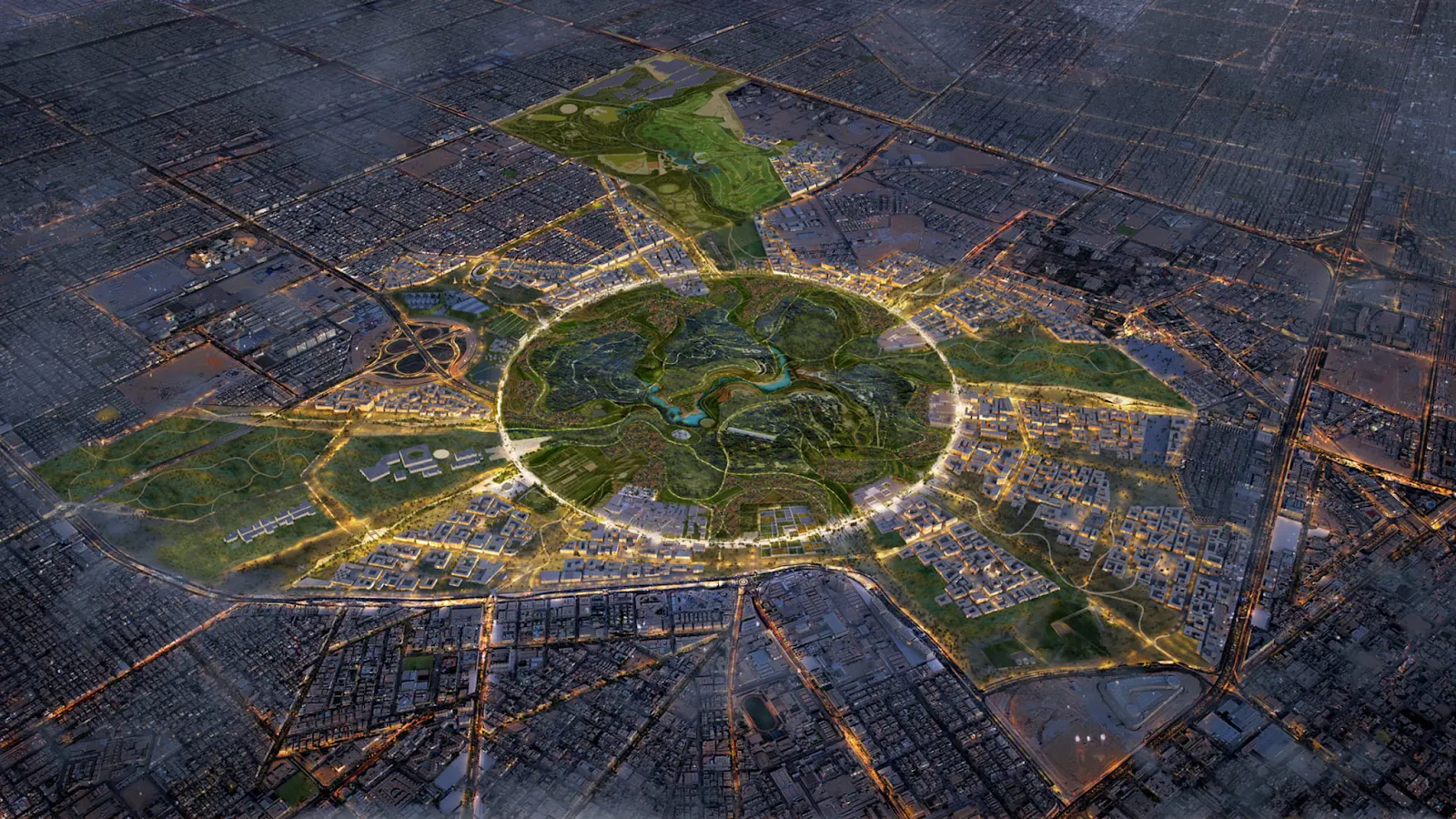
When Taglime named more than 250 assets for New Murabba, Riyadh’s new downtown mega-development, a single name routinely went through linguistic research, dialect checking, cultural validation, creative development, and multiple rounds of institutional approval. The process for one name could take longer than a full marketing campaign for a mid-size brand.
This is not inefficiency. This is what responsible naming for a permanent place requires. You cannot patch a name.
The lesson: scope naming as its own discipline. It needs its own timeline, its own approval process, and its own budget line. If it is buried inside a broader content brief, something will be rushed. And rushed names get carved into buildings.
Bilingual Means Two Different Conversations, Not One Conversation Twice.
This is the point I find myself making most often to international partners, and it is the one that takes the longest to land.
The goal of bilingual giga project communications is not to produce an Arabic version and an English version that say the same thing. It is to produce an Arabic version and an English version that achieve the same effect on their respective audiences. Those are different tasks.
A Saudi national reading the Arabic content of a giga project brings the weight of Saudi history, the emotional texture of what this land means, and a very specific relationship with what Vision 2030 is supposed to mean for their life. An international investor reading the English content brings entirely different reference points.
The same sentence, translated faithfully, lands differently because the cultural context surrounding it is different.
“Sustainable living” in English is in conversation with global ESG frameworks and international climate discourse. In Arabic, for a Saudi reader, the same concept enters a conversation with Islamic principles of stewardship of the earth and the specific geography of the Arabian Peninsula. These are not the same conversation. They require a different language to have the same effect.
This is what transcreation is for. And this is why the best giga project content is a bicultural communication exercise, not a translation exercise.
The Approval Process Is Also Your Job.
Nobody in a giga project content brief is going to tell you this, so I will. Navigating the institutional approval chain is part of the content work. Not adjacent to it. Part of it.
Giga project content does not get approved by a single client. It goes through the project communications team, the design agency, the international PR firm, the Saudi government entity that owns the project, and sometimes advisors whose names are never in the email thread but whose feedback appears anyway. Each layer has legitimate input, different priorities, and genuinely different ideas of what the content should achieve.
A single project may include Saudi engineers, British consultants, Indian developers, and American project managers. The content agency, has to hold the work’s integrity through all of it.
What this requires is cultural confidence: the ability to advocate for Arabic content decisions in rooms where most people cannot fully evaluate the Arabic. When a non-Arabic-speaking stakeholder in London wants to simplify a piece of Arabic copy because it “feels long,” someone in the room needs to be able to explain, with authority, why that specific sentence length is correct for Saudi institutional Arabic and what would be lost by shortening it.
That is not a writing skill. It is a cultural standing skill. And it is one of the most underappreciated things a Saudi-specialist agency brings to a giga project engagement.
When Taglime worked with Qiddiya on their Experience Center content, in partnership with a U.S. agency, the model worked because both sides knew their lane. Global brand framework from the U.S. agency. Saudi cultural intelligence and Arabic content from Taglime. Neither tried to do the other’s job. That model produces the best results, and it is increasingly how serious giga project content is produced.
What You Are Actually Building Is Infrastructure For Vision 2030 And Beyond.
The last lesson and the one that changes how you approach every other decision. A giga project’s content is not a campaign. Campaigns end. Content infrastructure does not.
The naming system, the Arabic brand voice, the dialect guidelines, the bilingual content architecture: these documents and decisions will govern everything produced under the project’s name for years, possibly decades. Every social post, every signage brief, every pitch deck, every press release will draw on the foundations that were laid at the start.
A campaign slogan that is slightly off gets retired at the end of the season. A giga project name that is slightly off gets carved into buildings.
This changes the standard of care required at the creation stage. It also changes the way commissioning teams should think about their content investment. The question is not “how much does this content cost?” The question is “how much does getting this wrong cost?” Across the life of a project the size of a Vision 2030 giga development, the answer to that second question is significantly larger than the first.
Invest in the foundation. A thorough Arabic voice document, a naming system with clear linguistic principles, a bilingual content guide that makes dialect decisions explicit: these are not deliverables. They are the infrastructure that everything else runs on.
Write Saudi Arabia’s Next Chapter With Us.
Taglime is a Saudi-focused copywriting and localization agency founded in Riyadh in 2017. We have named places, built Arabic brand voices, and written bilingual content for some of Saudi Arabia’s most significant Vision 2030 developments.
If your giga project has a content brief that needs Saudi cultural intelligence at its center, we should talk.
Get in touch with Taglime at [email protected] and see what we have been doing for GIGA and mega-projects in the Kingdom.
Frequently Asked Questions (FAQs)
What types of content do giga projects need from a copywriting agency?
Naming systems, bilingual brand narratives, website copy, placemaking language, campaign content, institutional communications, tone of voice guides, UX copy for digital platforms, and ongoing content production as the development evolves.
Why do giga projects need a Saudi-specialist agency rather than a global one?
Global agencies handle English well. Saudi-specialist agencies handle the Arabic problem: dialect selection, cultural validation, institutional approval navigation, and naming in Arabic. The strongest giga project content comes from a partnership between both.
How long does giga project content work take?
Naming alone for a large development can take six to twelve months. Brand voice development and launch content typically run three to six months. Ongoing content production continues for the life of the project.
How does Taglime approach bilingual giga project briefs?
Arabic and English develop in parallel, not sequentially. Dialect decisions happen at the briefing stage. Naming is scoped as a standalone discipline. Cultural validation is built into the process from the start.
Can international agencies partner with Taglime on giga project briefs?
Yes. Taglime regularly works alongside international creative, design, and PR agencies. The model is a clear division of expertise: global brand framework from the international partner, Saudi cultural intelligence, and Arabic content from Taglime.
If you have read this far, you understand what Taglime is better than any brochure could explain.
We look forward to making your brand the next story we give a voice to.
Reach us at [email protected] or visit taglimeagency.com